Problems, solutions, actors in a garbage can: how do we stir up the connections?

Research on decision making has been of interest to me for some time now. And, during my advise and consulting, I have come across a large number of entrepreneurs and managers struggling to make decisions, remain consistent in their decisions and make hard commitments to their decisions, as well as take ownership for the consequences of the decisions. I propose that such “under-decisiveness” (not being comfortable with their decision) is due to their inability to explain to themselves why and how their decisions are right (or appropriate). Some great research on this has been done in the past, and I would draw upon some insights from behavioural science research on decision making, some Indian philosophy, and some neuroscience. In this post, I introduce to my readers the concept of garbage can decision making, and its implications for managers and entrepreneurs.

Aha moments, first

In their recent article, David Rock and Josh Davis (Four steps to have more ‘Aha’ moments), urge decision makers to take breaks from the act of decision-making to make better decisions. In other words, sleep with your problems (no, I am not implying anything about your spouse!). The argument is that taking a break helps in (a) noticing quiet signals, (b) look inward, (c) take a positive approach, and (d) use less effort.

Quiet signals have been talked about in decision making literature in the past (almost the same as weak signals – I am not aware if quiet signals are any different). One of the best articles I have read recently about working with weak signals appeared at the MIT Sloan Management Review (How to make sense of weak signals). To summarise that article, Shoemaker and Day (the authors) urge us to follow nine approaches (see the exhibit in the article): 1) tap local intelligence, 2) leverage extended networks, 3) mobilise search parties, 4) test multiple hypotheses, 5) canvass the wisdom of the crowd, 6) develop diverse scenarios, 7) confront early, 8) encourage constructive conflict, and 9) trust seasoned intuition. If you would rather read a lighter article on how organisations can tap into weak signals, you may read what appeared in the McKinsey Quarterly (read here). The bottomline – listen more; listen to diverse sets of people; actively listen to conflicting views, and proactively build listening mechanisms and routines in your role/ function/ organisation.

To look inwards is easier said than done. Busy executives need to take their time easy. To quote my favourite analogy, which car needs more maintenance – the car that is been driven around between Whitefield and Bannerghatta Road in Bangalore, or the one that is being driven around a formula one track? The competitive formula one driver, driving at 300 kmph (or thereabouts) competing with other fast cars needs much more periodic pit stops than the car that is averaging about 6 kmph (okay, maybe 9 kmph), right? They busier you are, the more you need to take breaks. Taking breaks is not easy – you need to keep your mind active, right. That is where an active pursuit of another ‘activity’ is important. Build an alternative thing to do – I am not using the word ‘hobby’ deliberately. Build an activity that interests you, that you are passionate about. Something that motivates you enough to schedule your work and the ‘activity’ with relatively equal importance. One of my batchmates runs an internet aggregator, as well as competes in the triathlon. One another is a CEO by the day and a fiction writer by the evening. One another colleague of mine trains for marathons in the evening, is Dean for part of his time, and is Professor for the rest of the day.

I don’t need to elaborate about taking a positive approach. Enough research done about it. Using less effort is almost a summary of what is been said already. Take a break, do something else, listen to your own self, and then get back to the problem. You’ll be able to decide better. However, my thesis is that just these are not sufficient – it is like saying that by doing all of these (listening to more people, diverse people, yourself, and taking breaks) you will be able to improve your decision-making. I argue that it is also important to actively make the connections between data (collected through listening), insights (collected through listening to yourself), criteria (oops, we haven’t talked about it yet), and implementation plans (yes, yes, we will talk about this too).

Garbage can model of decision-making

Before we go into the process of what I call active decision-making, we need to understand the ‘garbage can’ model of decision making. Yes, you read it right, the garbage can! Way back in 1972, Cohen, March and Olsen wrote a classic article in the Administrative Science Quarterly, titled A garbage can model of organisational choice (read the abstract here). The primary argument is that decision-making is not as neat as it is taught in the first few sessions of your MBA curriculum, but it is much like a garbage can. In a garbage can, where actors (decision-makers) are looking for work; problems are looking for solutions; and solutions are looking for problems and decision-makers. Solutions are not created from ground up, but are available within the system; it is the active seeking by the decision-maker to match problems with solutions that matters most.

They label organisations as organised anarchies, characterised by problematic preferences, unclear technology, and fluid participation. In other words, organisations do not have clear priorities of projects and actions, unstable or immature processes, and there is a large (noncommittal) silent majority in every organisational decision making setting. Does it ring a bell? A lot of organisations have stated strategy, but the specific decisions made at the field do not reflect the organisation strategy; our organisational processes can do with a lot of discipline and consistency; and in every meeting there is only 20% people contributing to 80% of the voice.

Active decision-making

When we agree that organisations are indeed organised anarchies; and decision-making therefore reflects garbage cans, we need to work on making the connections actively, proactively.

Criteria is the first thing we need to focus on. Organisation’s strategy is one thing – every organisation claims to have one. Does the organisation actively translate the intent/ purpose and strategy into actionable criteria. I know of a variety or organisations where a lot of middle managers (and sometimes even senior managers) cannot translate the organisation’s purpose (or intent) into actionable priorities. when I ask them what their priorities in the next few years are, most of them cannot go beyond simple parameters like growth and profitability; and even if some of them do, very few of them understand why such actions are their priority. So, the first thing you need to is ensure that your organisation vision and strategy is translated into visible priorities and criteria for decision-making. In great organisations, every program, every decision, every initiative reflects their strategy and purpose.

Implementability is another under-rated aspect of decision-making. Every decision need to be implemented. One of my colleagues used to remark – effective decision making is when the decision-maker can take ownership for the consequences of the decision. Which means, the decision-maker should ensure that the decisions are implemented efficiently. Which means that the decision-making has to take into account the contextual realities right at the criteria and option-definition stages.

26-1-garbagecan

Summary

In summary, active decision-making requires the decision-makers to become both efficient and effective in their decision-making. Efficiency of decision-making is about the process of decision-making and effectiveness refers to the success of the decision. In order to ensure that good decisions balance efficiency and effectiveness, decision-makers need to pay sufficient attention to criteria/ options (effectiveness) as well as be aware of garbage can models, weak signals, sleeping over thoughts, active breaks (efficiency).

So, managers and entrepreneurs, even if you are muddling through, please balance efficiency and effectiveness of decision-making.

(c) Prof. R Srinivasan, 2016.
 

My platform business models journey

Writing this blog after a long gap. New administrative responsibilities at my school required me to invest some mindspace towards understanding the role, my team (and their roles), and setting up priorities and processes.

I am also figuring out how to respond to blatant plagiarism – some pages from this blog have been plagiarised (word by word, including my writing in first person!) and reproduced at another blog. For example, check this out: http://digiplus.runwise.co/network-mobilization-platform-businesses/ and how this page is different from the original post: https://srini108.wordpress.com/2016/05/26/network-mobilization-in-platform-businesses/. Another page that has been plagiarised is here: http://digiplus.runwise.co/building-platform-business-hard-work/, which is an exact copy of my post at https://srini108.wordpress.com/2016/05/03/building-a-platform-business-is-hard-work-not-for-lazy-people-a-response-to-prof-ajay-shahs-column-in-the-business-standard/. I have written to the supposed author requesting for removal of the infringing posts, but have heard no response. Plus, I have left comments at the bottom of the infringing blog pages that those pages were indeed plagiarised, but those comments are “awaiting moderation”. I have now learnt a lesson. All these pages now come with an explicit copyright assignment, and I am going to make it difficult to plagiarise with increasing use of personal pronouns.

Today morning, I was asked by our Dean to present the evolution of my research, teaching and consulting interest in platform businesses. It was an interesting exercise of thinking through the evolution over the past three years. In this blog post, I intend to capture a  short glimpse of the same.

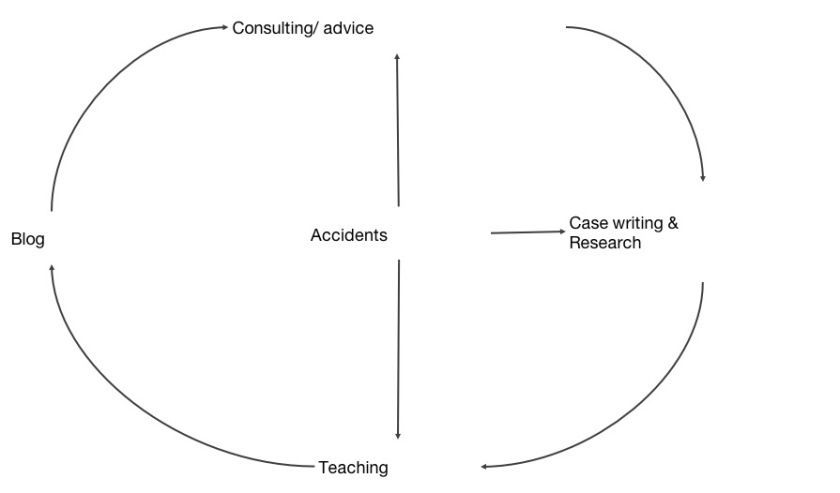
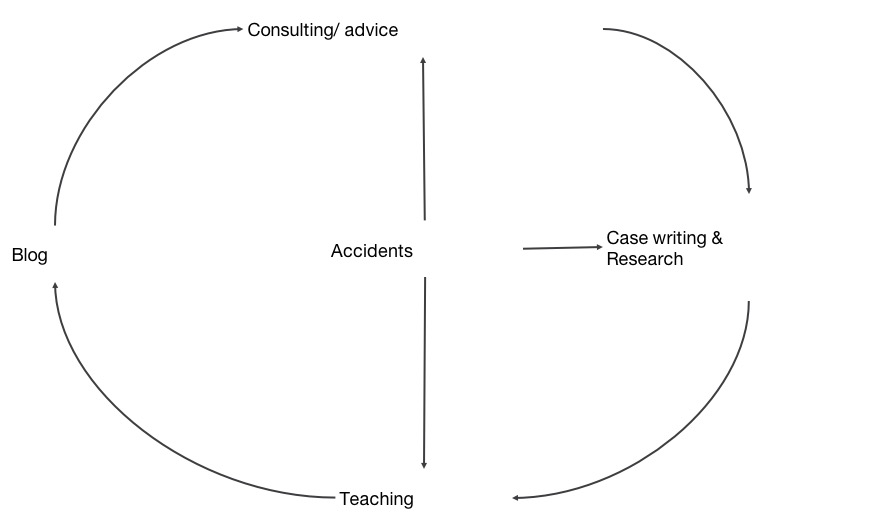
A network of accidents

It all began with a network of accidents. Three accidents to be precise. A dorm-mate from over 20 years back invited me to his company (he had just relocated to Bangalore) for a short discussion on product design ideas. When I went there, I discovered that apart from him, there were enough members of his team who were my students at both IIMB and IIML. Which made the discussion interesting and lively. The “product” that they were developing was actually a platform for the FAs to serve their business process outsourcing customers. And we had a fruitful discussion on the economics of platforms, why network effects are important to understand, and how can the company monetise the efforts, if they chose to (subsequently, they chose not to monetise the platform directly).

The second accident was when a colleague of mine at IIMB could not attend an event his friend was planning. This friend was an entrepreneur setting up a business around pharmaceutical retail supply chain, and had invited his “Professor friend” to talk to his customers (pharmaceutical distributors). My colleague could not attend the event, and requested me to stand in for him. I travelled to Chennai, had an eventful breakfast with the founding team; and over a couple of aloo parathas (potato filled Indian bread), changed their business model from a SaaS model to a platform business model. The said breakfast meeting, I am told, is currently a legend in the company history/ water cooler talks.

The third accident took place (though not in the same chronological sequence as being reported) when another colleague of mine from the Quantitative Methods was leading an team writing a case on a firm. The case writing team felt that there were more strategic issues in the case, and invited me to join in one of the meetings. During the meeting, it was apparent that the firm was transitioning from being a product firm (selling boxed software) to a platform-based business, where product was just a hook for a variety of other services and value propositions.

Consulting and advice leading to case writing and research

These three accidents led me to document them as cases, and I began providing advise/ consulting to some of them. I got introduced to more firms operating platform businesses, and discovered that some of these entrepreneurs were actually making decisions about platform businesses, quite intuitively, without actually knowing the theoretical work behind the same. And boy, weren’t they successful! They have survived the dot-com bust, a series of recessions, and the growth of digital businesses. More learning talking to these entrepreneurs (academics call this as grounded theory). More cases followed, and I began to understand the economics behind the same. I initiated a series of projects around the same, got funding from IIMB and FAU for the same, and wrote a series of cases.

Evolution of the course(s)

As the number of cases bludgeoned, I was invited by the FAU (http://wi1.uni-erlangen.de/) to teach a course on digital business, and I latched on to the opportunity to launch a course on platform strategies. That one course led to another, and I offered an improved version of the same at IIMB immediately thereafter, and then as the number of cases grew, and I began filling in learning gaps, offered a larger version of the same at IIM Trichy. And now both the FAU course (http://wi1.uni-erlangen.de/teaching/strategies-platform-mediated-organizations) and the IIMB course (http://www.iimb.ernet.in/node/5610) have now become 5 ECTS and 3 credit (full thirty hours) courses.

This blog

As the courses matured, I began writing a lot of notes for myself. In fact, true to a business school professor, I would typically prepare for the class, get a lot of insights to share with the class, share a few in class, and the rest of them would remain in my notes. Some of my students continued to urge me (no, I am not substituting it with encourage) to write a blog. And I began this blog in April 2016 (once my course was over). My teaching assistant, who travelled with me to IIM Trichy and took copious notes of my classes was extremely helpful in ensuring that the information loss from the class discussion to the written notes was minimised.

Blog leads to more connections and research

Based on this blog, some of you came back to me seeking specific advice on setting up and running platform businesses; I engaged with a few firms, and more cases followed. The blog now has led me to more connections, and spurn on more research questions. In the meantime, a lot of my PGP and EPGP students have undertaken projects on specific questions around the platform business models (I will run a series on those projects in the next few weeks), and more insights and research questions emerged.

24-1-journey

The journey has been exciting, I have learnt a lot. And hopefully, things will continue.

(C) 2016. R. Srinivasan, IIM Bangalore.

Stages of Digital Transformation

A lot of people confound digital transformation with information technology and automation. Automation of processes would lead to increase in efficiency, quality, and additionally, transparency, and fairness in the case of services. Industries have been transformed in the last few decades in such a manner that what is visible to the outside world is the information technology. What is not so much visible is the painstaking work that goes on in the back-end to support this transformation. In this blog post, I will highlight the stages of digital transformation, building on my previous blog post on digital transformation (read it here).

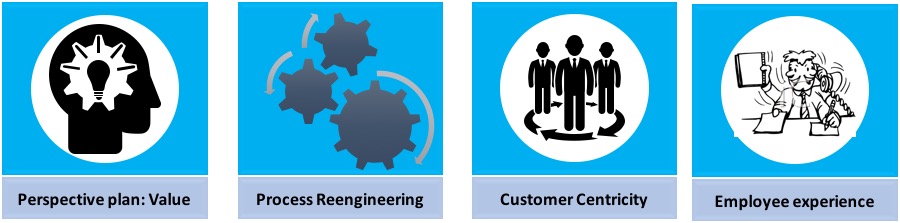
Four stages of Digital Transformation

23-2-process

The transformation for digital transformation at any organization begins with the definition of a perspective plan. It is absolutely critical that the entire journey is considered an intrapreneurial action – a new business project/ plan. Within the confines of the existing business model, constrained by the extant resources and capabilities, it is highly unlikely that mature organizations can question their status quo. I would therefore suggest that organizations set up independent empowered venturing teams to take the digital transformation journey forward. With appropriate leadership commitment to change and a vision of the future, this venturing team should draw up the perspective plan.

A key component of this perspective plan is the definition of the value that you provide in your ‘transformed’ state. Value is an over-used word in this context, but I will risk using that again. What is that additional/ different value that the transformed organization intends to provide? Take the example of Airbnb.com, that competes with traditional hotel chains. Without owning a single hotel room, Airbnb.com transformed the entire travel/ hospitality industry through the provisioning of basic rooms. While traditional hotel chains behaved like legacy airline carriers, continuously improving “the experience”, Airbnb.com began providing just bed-and-breakfast, but with a different “experience”. The customers might meet more like-minded travelers and hosts at Airbnb.com than at traditional hotels. In just as much the same way low-cost carriers disrupted the legacy airlines industry, Airbnb.com changed the way people looked at travel – it was no longer luxury that one looked for, but something new and exciting. And with their business model, Airbnb.com had the ability to scale up capacity seamlessly in any city, town, village in any country (legal troubles notwithstanding).

Superior customer value cannot be provided unless the organization focuses on re-engineering its back-end processes. What may be visible to the outside world are the rejigs on the front-end, but the back-end process reengineering is the core to successful digital transformation. It is how efficient the back-end processes are, and how the front- and back-end processes talk to each other that matter the most. Imagine the world before the airline ticketing portals. One would have to call in to a travel agent, who would access the reservation systems of different airlines and provide the consumers with limited choices (and in most cases those choices that made him the most margins), and very little flexibility. What these online portals did was to provide consumers with unlimited choice and flexibility, including crazy organizations like https://skiplagged.com. The customer experience changed significantly, primarily because these airline ticketing aggregators could create back-end processes that would extract the schedules and fares, including connections and code-share agreements. It is the based on the strength of the back-end that supports the transformation of this industry. Same is the case with Uber (or any of its competitors or partners) – the back-end that seamlessly connects drivers and riders based on the geo-spatial data captured from their devices. Traditional taxis focused on automation of billing and other front-end services, whereas Uber disrupted the market with back-end re-engineering.

The importance of customer centricity could not be missed in this process reengineering. The customer experience has to be the center of any such reengineering. Good reengineering imagines the customer journey throughout her experience with the organization and its product/ service as it happens chronologically. Like a relay race, the customer “baton” has to be passed on from one organization unit to another seamlessly that the customer should not experience the passing of the baton at all. Organization design that promotes concepts like the key account management (KAM) or single point of contact (SPOC) facilitates such experiences, and it is critically important to keep these customer journeys in mind while redesigning the processes. For instance, take the case of how loyalty programmes work. You rake up your points/ airmiles from one product/ service and struggle to spend those points, as the options for redemption are highly limited. Yes, these days my credit card company and my airline frequent flier miles are merged, as I use an airline-co branded credit card. Even then, my credit card spends get added to my airmiles that I cannot redeem for anything else other than the limited choice provided. Here is where disruptions like WorldSwipe can help (read more about WorldSwipe here), where the platform has partnered with a variety of organizations from where consumers can earn their points, and a much larger variety of outlets where they can redeem their points. For instance, an electrician buying cables and earning points from his favorite electric cables brand can redeem his points by buying cellphone minutes from his favorite telco. [Disclaimer: I advise them]. Imagine the processes reengineering required from the cable company, as well as the telco in order for this loyalty to work; and the extent of consumer insights that could be captured as this platform grows and matures.

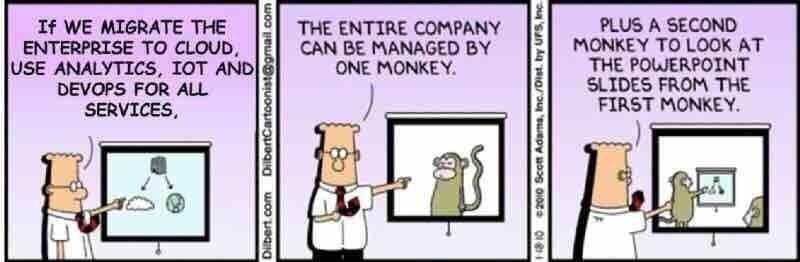
In the process of defining and reengineering the processes, it is important to keep the employee experience as well in mind. When customer experience dominates process redesign without regard for the employee experience, the whole system collapses. Take the case of your ecommerce grocer’s last mile delivery persons. These employees, are possibly the lowest paid in the entire chain, and yet, they represent the face of the company to the consumers. The consumer interacts with the company only through her mobile phone or tablet, and then these delivery persons land up at her door. Fullstop. Consumer experienced your product/ service. How critical is it to understand and design the processes that traces the employee experience journey! I have heard horror stories of how these employees in cities like Bangalore are provided with unrealistic delivery targets, without proper consideration of traffic situations, parking issues, and consumer non-availability at home situations. Add cash-on-delivery complications where these employees have to not just deliver goods, but collect cash for the same as well. Complicate this a little further with card-on-delivery and associated network connectivity issues. Once you live through the employee experience journey, you would realise how important it is to balance the process reengineering effort between the customer experience and employee experience. A lot of time, basic training and skill-development may be sufficient, but training on customer service orientation, attitude, and service quality would go a long way in enhancing the employee experience and engagement. Just make sure that your organization does not go towards employing two monkeys (as below).

23-1-automation-dilbert

On Tuesday this week (06 September 2016), The Mint newspaper carried a special issue on the digital future. One of the articles in that edition was by Jaspreet Bindra from the Indian automotive major Mahindra & Mahindra, titled “The 10 Commandments of Digital Transformation (read it here). Coming from someone with a varied experience like him, it is worth reading through. His 10 commandments does touch upon what I have elaborated plus much more.

Enjoy your digital transformation journey!


Regulating Platforms

Over the past few months, there have been a lot of disputes between platform businesses, governments, and a lot of these have gone to courts as well. Last Friday (26 August 2016) issue of the Mint newspaper carried an opinion piece titled “the tricky business of regulating disruptors” (read it here). The editorial while labeling almost all platform businesses as disruptors, just stopped short of calling all of them disruptors. In this blog post, I dig deep into the issue of if and how platform businesses need to be regulated with respect to consumer protection, without impeding innovation and thence providing fair business opportunities to businesses (and returns to investors).

Defining the industry boundaries

One of the key determinants of “competitive” behavior is the definition of the relevant industry. What is competitive and what is anti-competitive can depend on how narrow or broad you cast your net while defining the industry. For instance, the Mint editorial explains in detail how in a 1953 verdict on DuPont’s monopoly on the cellophane as a result of “result, business skill, and competitive activity”, despite having over 75% market share in the cellophane market, because the courts defined the “relevant” market as flexible packaging material, and not cellophane, the product. However, in most cases against platform businesses like Uber, the competition commissions and other regulators have defined the market as app-based taxi services, and therefore looked at the market being usurped by monopolies (Didi-Uber combine in China) or a duopoly comprising of Uber and a local operator (like Grab in SE Asia, OLA in India, Lyft in the USA).

Is Uber a competitor or substitute to Taxi?

In a detailed response to Prof. Aswath Damodaran’s 2014 article on Uber’s valuation (read it here), Bill Gurley (a series A investor and board member of Uber) defined three things (read Bill Gurley’s blog post here).

  1. He argues that Uber has since transformed the industry so much that one’s market size estimates based on current taxi market sizes is flawed. In other words, Uber was providing customers with far more value and a very different set of value propositions than a traditional taxi service – quick discovery, easy payment, predictability of service, quality (dual rating of riders and drivers), and trust/ safety. He talked about how Uber’s customers are using it to transport young adults/ children or older parents in the “comfort and safety” of an Uber, rather than a taxi.
  2. He argued that given the economies of scale that arose due to the positive cross-side network effects, more and more drivers and riders adopted Uber, and Uber expanded to more and more geographies, and the prices fell. And the price elasticity contributed to more demand and therefore more network effects. The economics of Uber (and therefore other ride-hailing app-based services) are very different from the city Taxi services.
  3. Uber is not a taxi alternative – it is a car-ownership (or a car-rental) alternative. When the liquidity (availability + density) of Uber vehicles is so high in every geography you want to travel to, you would rather not rent/ buy a car, but use Uber. The convenience and reduced cost of Uber as an alternative to ownership is something that he substantiates with data and analysis.

In other words, Uber was indeed a disruptor, and therefore was entitled to be treated as a separate industry. It is not a competitor to the for-hire taxi, it is an alternative; much the same way Kodak was bankrupted by digital photography (and not by competitors like Fuji).

Creative destruction and Schumpeterian waves of technology innovation

The Mint editorial called for Honorable Judges to not set taxi fares, simply because these disruptors would transform the industry through their technology innovation, and any restraining regulation would hinder these Schumpeterian waves. It is therefore an indirect call for letting these disruptors alone, let the waves of Schumpeterian technology innovation hit the markets, before we arrive at a stability of sorts. Regulation can wait.

Can regulation wait, and allow for a disruptor, in the excuse that the market is a “winner-takes-all” market monopolize the market? The popular arguments against monopolies is that of consumer protection, and that when monopolies rule, consumers suffer – prices rise, service levels fall, and there may be no alternatives. This is exactly the case for another wave of creative destruction.

My primary thesis is that when such disruptions happen on the basis of network effects, leading to economies and scale, and the disruption is based on parameters like improved customer service, lower prices, and transparent/ fair transactions (trust/ safety and the like), monopolies are not necessarily bad. When such monopolies emerge and the customer experiences deteriorate, as dictated by traditional industrial economics theory, the market will be ripe for another wave of Schumpeterian technology innovation. The waves of market entry in the Indian airlines market is testimony to these (1990s – privatization and shake-up leaving two state-owned and two private competitors; 2000s – entry of low-cost carriers leading to the demise/ consolidation of all stuck-in-the middle competitors; 2010s – entry and strengthening of regional airlines, is it?) waves of creative destruction.

Yes, there is space for other competitors, but not so much for Uber replicas. The market is indeed a winner-takes-all market (as I have argued in the past), and therefore there is just enough room for small, losing replicators. Look around the markets for Uber competitors, you do not find any market fragmented. While differentiation and creating niches is the prescription for firms competing with Uber, I request the regulators to begin treating such platform businesses as an independent market and let the inefficient product-markets fail, if required. No one cried when the offline ticket counters of Indian Railways are declining sales, thanks to the volumes garnered by IRCTC (some claim that this is the world’s largest ecommerce platform, is that true?). No one complains about bookmyshow.com garnering huge market shares in the app-based movie seat booking market, claiming that the livelihoods of the ticket clerks are under threat. Why cry about Uber, or for that matter, OLA, Grab, or Lyft?

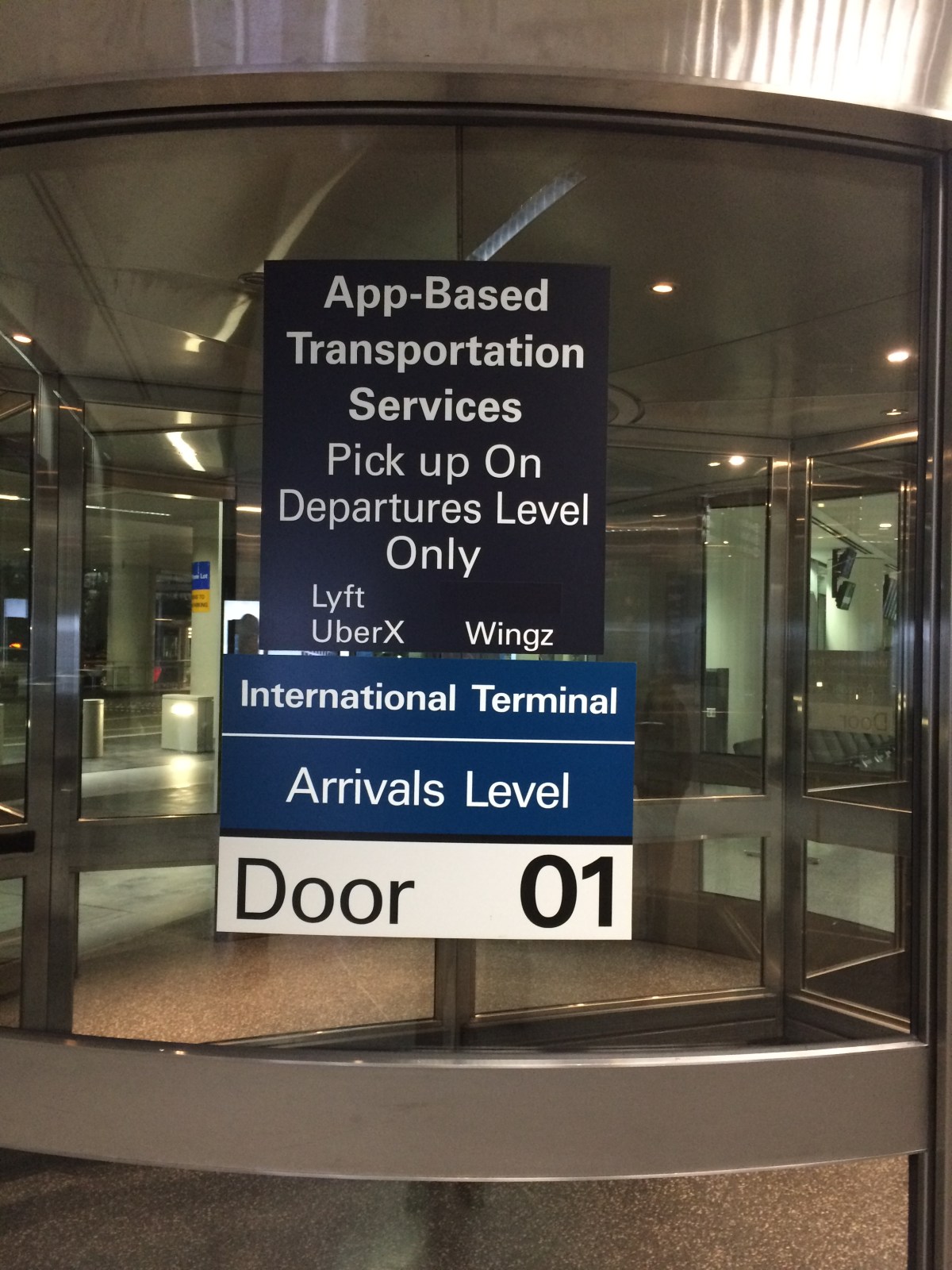
There is already sufficient discrimination against these disruptors. In a recent visit to San Francisco, I made an extra effort (okay, walked down a flight of escalators) to click a picture at the SFO airport that read, “app-based taxis to pick-up from departures level”. Honorable Judges, please leave them alone, enjoy your ride/ movies/ every other service, contribute to the economies of scale, and let the market be disrupted.

Cheers.


Social Buffering – Is it lonely at the top?


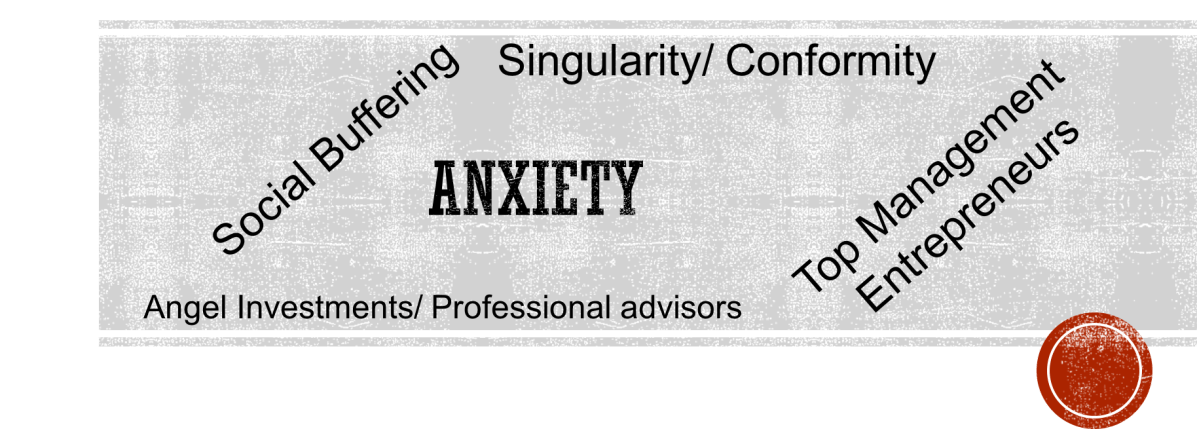
Yesterday (24th August), I connected three dots. First dot: I met with a couple of my friends from 20 years back (we were batchmates) – one of them celebrated his tenth year of entrepreneurship this week, and another was taking baby steps into entrepreneurship in the last three months. Second dot: I read a piece on LinkedIn on why Samsung cannot be Apple. Third dot: I read an article in the Strategic Management Journal (SMJ) on executive anxiety. And tossing and turning on my bed, late in the night, the three dots connected. Voila.

Dot #1: The entrepreneurial fetish with fund raising

When two entrepreneurs meet with a business school professor, it doesn’t take long for the conversation to veer from business models to fund raising. So it did happen yesterday. The conversation was going towards evaluating if angel investing is better than crowdfunding, and we agreed that the money raised is much less valuable than the insight/ knowledge/ resources/ network the angel investor(s) would bring in. Isn’t that why those investors are called “angels”, as they have some magic wands in their hands? Slowly, bit by bit, I evaluated their business plans and broke the entire fund requirements to an amount that was so small that they would not take money from anyone other than one with an enormous network or experience in that domain. As entrepreneurs, it was extremely important that they realize that money from the right source is far more valuable than the denomination of the currency (or the balance in the bank). The value of the advice and mentoring the angel investors bring in is severely under-rated in today’s entrepreneurial ecosystem. Here’s calling all entrepreneurs to evaluate your list of mentors – what specific insight, learning & knowledge, experience, resources, network do each one of them bring in. Prune/ add ruthlessly.

Dot #2: Singularity

The drive back home from North Bangalore to South Bangalore in the evening traffic is not something I enjoy, unless I have some company or reading to do. Yesterday, I had both. The reading was this LinkedIn post by Anish Behera on Why Samsung will never be Apple? (read it here). If you have returned back to this blog after reading his piece, you know where I got the three dots idea from, right!

His primary argument is that it was important for Steve Jobs and the American culture to be autocratic and not suitable for Korea and Samsung. He argues that American culture of Singularity is more suitable for innovation than the Korean (in fact, he extends his argument to most of Asia as well) culture of Conformity. Though I am glad that he included Mahindra under the singularity dimension, I think it is a slight stretch. But that is a different debate and discussion.

The substance of his argument was that Apple ha(s)d both singularity (one person) and an opinionated (non-conformist) culture that fostered innovation. What it means for entrepreneurs of today is not so much to create a person who is as charismatic (and possibly maverick) as the leaders he quotes, but to have a singularity of purpose that guides decision making. Strong vision, broader search for alternatives, speed of decision making, and discipline in execution arise out of singularity and non-conformity. Both, together; not a preponderance of one over the other. Pure singularity without a culture of non-conformity would result in a narrow search of alternatives and may lead to phenomena like groupthink. Non-conformity without a strong purpose and direction would result in slow decision making and lack of discipline in execution, and may to phenomena like predictable irrationality.

Dot #3: Social buffering

A couple of weeks ago, Apple CEO Tim Cook asked, “Hey Siri, why am I so alone?”. In an insightful interview with The Washington Post (read it here), he talked about a variety of things including not being able to replace Steve Jobs. But what caught my attention yesterday was the statement that “running Apple is sort of a lonely job”. And when I read an academic article on the Strategic Management Journal (yes, that is my primary job) by Michael J Mannor, Aadam J Wowak, Viva Ona Bartkus, and Uuis R Gomez-Mejia titled, “Heavy lies the crown? How job anxiety affects top executive decision making in gain and loss contexts”, (SMJ, 37,9, Sep 2016) the dot #3 emerged. The heavy crown of leadership can lead to significant anxiety in top executives (so beautifully articulated by Tim Cook when he talked about how he prepared for a congressional hearing – have you not read the interview, yet?). An effective insurance against such anxiety is to surround oneself with a team that is supportive of one’s decisions, effectively buffering the executive from threats from the environment. Building such a supportive team, that shields the top executive from the external world without a risk of opportunistic behavior from the buffer themselves is what the authors label as social buffering.

The implications of social buffering (according to the authors) are three-fold. Higher the perceived threat from the external world (and therefore the anxiety of the top executive), more likely the social buffering behavior. Secondly, in spite of the social buffer, it is likely that anxious executives might be more risk-averse than others. And finally, in contexts that represent losses (rather than gains), executives would be more likely to build strong social buffers. For instance, executives leading firms in declining product-markets may build stronger social buffers than those in high growth contexts. To put this in simple terms, the more vulnerable the top executive feels about the environment, the more she will surround herself with supporting team members (who share the same thought processes); it will make her more risk-averse; and more so, when faced with losses (than gains). Given that loss aversion is more pronounced (executives worry more about losses than celebrate equal quantum of gains), this social buffering can become more and more pronounced in malevolent environments.

Connecting the dots

Find an investor who “has been there, done that” + Build a culture of singularity & non-conformity + Beware of social buffering

While it is important that you seek angel investments from someone who brings in a lot of experience, insights, expertise, and a network, it is also imperative that you build a culture of singularity and non-conformity in your organizations. If you do not pay active attention to these details, you may end up surrounding yourself with a social buffer, promoting and highlighting only those in your network who conform to your thoughts and beliefs while letting others go, you run the risk of running your enterprise to the ground with high anxiety, low risk appetite, and conformist thinking. Without an active innovation programme, replication and possibly fast following strategies are likely to dominate the organizational discourse.

Prescriptions

  • Seek out investments carefully. Do a proper due diligence of your investors’ resources and networks
  • Keep checks on how your advisors and investors encourage/ dissuade innovation and risk-taking
  • Make sure that you surround yourself with a variety of perspectives, and ensuring that your social buffer is not counterproductive to your innovation and external orientations

Cheers.

Building your brand

This is not a post about marketing, though it may sound so. This is a post about how entrepreneurs and leaders communicate. This is relevant for brands and firms as well. Read on.

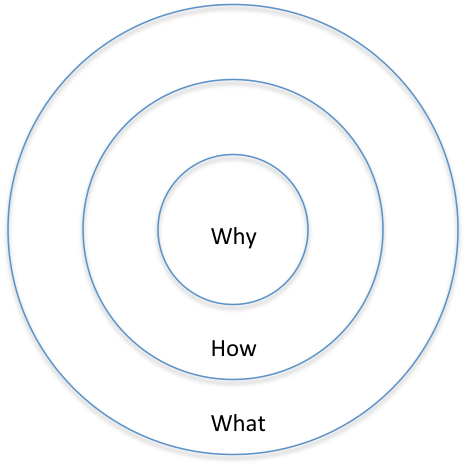
I listened to a very insightful TEDx talk by Simon Sinek on inspirational leaders. Listen to it here. He talked about how inspirational leaders focus on the inner most ring of what he called the golden circle. In the inner circle is the why, followed by the how, and then the what. He cited examples of ineffective communication, when firms and brands and individuals focused on the what to drive the how and why, and how successful people and brands and firms focused on the why first, before highlighting the how, and what. If you have not listened to it yet, please do so, before you proceed.

19.1 Brand communication

As we see a tramline of enterprises biting the dust, liquidating/ selling off to powerful competitors/ selling off at a fraction of its past valuations to firms in complementary businesses, this message is becoming far more relevant. Couldn’t resist this contrast …

Yahoo is a guide focused on informing, connecting, and entertaining our users.

https://about.yahoo.com/ 

Google’s mission is to organize the world’s information and make it universally accessible and useful.

https://www.google.com/intl/en/about/company/


Just take a look at how these two pages are organised – Yahoo’s page flows like this – a statement of what they do – inform, connect, and entertain; how did they start, how is it to work for Yahoo, and what does it offer for developers, advertisers, partners, and research. Google’s page begins with the company overview (that includes their history), who they are (culture and locations), what they believe, and then what they do.

If your communication focuses on what problems you solve (why you exist), and then lead towards how you solve those problems, and therefore what products and services you offer; I am willing to listen to you. On the other hand, there are entrepreneurs and firms that begin with what they do. For instance, early this week, I heard someone talk about building the Uber of Indian tractors for farmers (if the one who talked about this is reading this, don’t take it personally). I had to probe deeper and deeper to understand what problem was being solved and why did Indian farmers needed a mechanisation solution in the lines of Uber.

Virgin’s Richard Branson also wrote today (11 August) about why successful entrepreneurs should seek problems, and create solutions (read it here). Begin with the problem and the opportunity; the business model and the solution will follow; and thence products and services.

So, whatever brand you are building – of yourself, your firm, your products/ services, please begin with the why, the how, and then get to what. Build a robust brand that stands for something, signifies why it exists, and speaks to the ecosystem on why it exists. Remember the arrow that connects A and z in the Amazon.com logo? Everything from A to Z.

And in today’s world, as firms simultaneously diversify and depend on a cluster of complementors to provide (each others’) customers with unique value, it might not be out of place to conceive of your brand as a platform. A simple platform (like how the automobile companies use the word) upon which your complementors and partners could build on, customise, co-develop, co-innovate, and co-create. Brian Monahan’s post titled “More than a promise: Brands are platforms” (read it here) develops this argument very well. Brian’s primary argument is that brands transcend the promise and should allow for other firms and its partners to shape the consumer experience. Imagine brand Android!

Borrowing the idea from Simon Sinek’s talk, leaders communicate why more than the what. How is your brand communication structured?

Would love to listen/ read/ hear about your brand stories.


Obliquity – muddling through in entrepreneurship

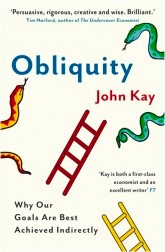
Through my travel to the other side of the world last week, I read a couple of books. One of them was Obliquity by John Kay. The subtitle of the book reveals more than the title – why our goals are best achieved indirectly. In this post, I intend to build on my reading of the book, adapt a few ideas, and draw implications for platform-business startups. This is not an exhaustive review of the book – there are a lot of them available online; rather this is a summary of my notes from the book, which I thought was relevant for entrepreneurs.

What do you pursue?

The book builds on an intuitive understanding that relentless pursuit of anything does not take you where you want to go; as much as reaching there obliquely. Happiest people do not pursue happiness, and are happy because they do not actively pursue happiness. They enjoy what they do – their work, their roles, their chores, and are even not sure their activities will lead them to happiness. If you have not yet seen the movie, The Pursuit of Happyness, see it now. It is the experience that matters, not so much the outcome. Successful entrepreneurs startup to solve a world problem, at least something they faced themselves, and not make tons of money/ billions of dollars of valuation. Those that actively play the valuation game – yes I call it a game – do not optimize. Those who are constantly looking for exit options have not been successful. The book is replete with examples of firms whose intent to make money, and how they floundered.

Eudaimonia

Drawing on Aritstotle’s concept of Eudaimonia, Kay classifies three levels of purpose people and firms pursue. The lowest level is those of momentary happiness – like waving at a child smiling through the school bus window; the intermediate level may include a persistent sense of well-being, like a good holiday with family and friends in the Andamans (I have not been there, yet!); and the higher level of pursuit is what is referred to as Eudaimonia, something like the satisfaction of having a patent granted. Something that is fulfilling, achieving something that tells you that you have reached your potential. When I teach strategy introduction sessions, I draw upon vision and mission statements of a variety of (successful) firms to speak about how these statements are actually altruistic and ephemeral, conveying a larger sense of purpose. Consistently, firms that add shareholder value in their vision/ mission statements have faltered, to either rediscover themselves or bite the dust. So, entrepreneurs out there, what is your Eudaimonia? Appreciate that in ancient Greek philosophy (we are approaching the Olympics, right?), “the final end of action is realised in action, and is not a consequence of action. Eudaimonia is a goal set before each agent as soon as he starts to act; it is not chosen and cannot be renounced.” Define why you are in business, and what is your high-level pursuit?

Obliquity in problem solving

Okay, solve this brainteaser for me (cited in page 50-51 of the book). A man sets off walking a mile to his home from his work. As he starts, his dog sets off to meet him on the way, and when it finds him, licks his hand and returns back home. And continues do so (run towards the master, lick his hand and return back home) till the master and the dog reach home together. If the man walked at a speed of three miles per hour, and the dog at twelve miles per hour, how much distance did the dog cover?

You can calculate this distance using the principles of infinite series, but that would be a long-winded calculation. If any of you noticed, the dog was four times as fast as the master, it must have walked four times the distance the master walked in the same time, viz., four miles. This is what Kay refers to as oblique problem solving.

Oblique is simple, direct isn’t. What problems of your customers, partners, stakeholders are you solving? And how – directly, or obliquely? When Tally (www.tallysolutions.com) began selling computerised accounting solutions way back in the 1980s and 90s, their mantra was simple – keep the user experience simple, which translated into replicating the offline processes exactly in the online product. The trial balance looked the same, the ledger entries looked the same, and the end result was that every accountant was already familiar with Tally, when he finished his accounting degree. The “power of simplicity”, which incidentally is their corporate punchline, arose from their intent to not simplify the lives of the accountant, but to exactly replicate. Had they begun simplifying, I am not sure they would have attained this iconic status (and market share) amongst the millions of Indian small and medium businesses (SMBs).

Muddling through

People familiar with academic research on Organization Behavior would have heard of this term “muddling through”, first articulated by Prof. Charles E Lindblom in his seminal paper, “The Science of Muddling Through” (see the paper here). Kay concedes that obliquity is a (better) euphemism for muddling through, and elaborates on how goals, decisions, and actions are different across the direct and muddling through approach (see figure 7 in page 66-67 of the book). A quick summary for the not-so-academically inclined: muddling through represents a state where (a) goals are multi-dimensional and loosely defined; (b) goals evolve over time, in fact, even after the action has begun; (c) the external environment is complex – the structure of relationships is continuously evolving; (d) interactions amongst stakeholders is socially constructed; (e) the external environment is not known, and is uncertain; and (f) the range of events, and therefore the options available in front of the firm/ decision maker is unknown and uncertain. In such a complex and uncertain environment, decision makers engage in “successive limited comparisons of non-comprehensive actions”.

Entrepreneurs do engage in a variety of muddling through. We talked about pivoting and bricolage in an earlier post in this blog (Pelf). As the environment you encounter is uncertain and/ or complex, you are entitled to muddle through! However, do not lose sight of the higher level pursuit, your Eudaimonia. In the absence of the larger sense of purpose, muddling through will remain just that, and not lead you to your ultimate pursuit.

Ex post justification of random outcomes

Kay discusses in detail about how England footballer, David Beckham could “bend” the football, performing multi-variable physics calculations in matter of seconds as he takes a free kick (read a wonderful reporting about it in The Telegraph here). I am not convinced (like Kay) that David indeed did all those calculations, or did Wasim Akram and Waqar Younis, the early exponents of reverse swing in cricket seam bowling, or even exponents of the ‘legal’ doosra or carom-ball deliveries in spin bowling. They had some idea, tried something, experimented, experienced a difference, persisted, perfected and professed (subsequently). Ex post justifications, all of them. A lot of entrepreneurial successes and failures are also subject to the same phenomenon. Now that a famous startup firm has sold out, all the arm-chair analysts will bring out their own analyses on why they saw this was coming. Search on the Internet about the merger of Uber China with Didi Chuxing – you will find a lot of ex post justifications on why this was waiting to happen. There are relatively very few insights/ posts of what that means for other competitors, and how Lyft, Ola, or Grab would feel the impact; or even why Didi Chuxing decided to buy out a competitor so small in size and give its shareholders a share of their own pie. So, when you encounter ex post justifications, just concede to randomness, reflect to learn (you use the rear view mirror of the car to drive forward, right?), and continue forward.

So, in summary, entrepreneurs of today, define what is it that you pursue, what are your higher level goals, and what is your Eudaimonia. Appreciate that obliquity in decision making is here to stay and be prepared to muddle through the environment and indulge in some arm chair ex post justifications of performance.

Shameless self-promotion

By the way, if you are in Bangalore and are available on Saturday, the 6th August 2016 forenoon (0950am onwards), you are invited to attend a panel discussion I am moderating on “Network Mobilization in Platform Business Firms” as part of the IIMB’s entrepreneurial summit, Eximius 2016. For more details, please visit http://eximius-iimb.com/4startupsnsrcel/. Free, mandatory registration at the website.


Reference class forecasting using pluralism: Fighting single parameter obsessions

Traveling around prestigious Universities and Business Schools in the US this week on an institutional assignment (this post comes from Chapel Hill, NC), one thing struck me in this society, pluralism. I read with interest my friend Suresh Satyamurthy’s piece in yourstory.com (link here) that uses a hangman metaphor for an investor review in the start-up world. In Suresh’s start-up world, the investor is hung-up on a single parameter – scale (pun intended). It set me thinking – any evaluation of performance (more importantly, assessment of future performance) needs to be grounded in as many parameters as possible. In this post, I will introduce Reference Class Forecasting (RCF) as a technique for fighting such biases like single parameter obsession. Drawing on research on behavioural economics, I attempt to provide guidelines for entrepreneurs and investors to make better forecasts of future performance.

Intent-outcome relationship

This is possibly the first and the most obvious starting point of any assessment. Start with what was the intent in the first place. If the stated intent of the platform was to transform the industry, please define what is industry transformation and measure those, and not start harping on profitability. Not every business needs to show the same kind of performance on the same parameters. Take the example of baby products company, firstcry.com. The founders’ motivation to start-up arose from the difficulty in finding products for their own children – availability, variety, poor quality, and certain international products/ brands not available in India (read their interview here). So, the best performance metric for assessing the performance of firstcry.com would be to see if they have been able to “make a wide variety of good quality international products and brands available to parents”. The performance metrics would therefore be (a) number of outlets – online and offline, (b) inventory size and variety, (c) number of brands, (d) number of products uniquely available at firstcry.com, at least in a specific geography, and (e) number of parents reached. Scale here would mean growth in number of customers, brands, products, and channels. Not GMV, not anything else. Yes, profitability is important, but not the first parameter of success.

Constructs, variables, and measures

Hmm, I may sound like a research methods teacher, but I think this is important to understand. Everyone (at least those reading this blog post) understands that everything could be measured in a variety of ways. A construct is an attribute of a person/ entity that cannot be observed or measured directly, but can be inferred using a number of indicators, known as manifest variables. For instance, entrepreneurial success is a construct that is measured by a variety of variables ranging from firm performance, firm growth, market power, firm’s influence in industry standard setting, pioneering innovation, to even investor wealth creation (or exit valuation) at sell-out to a large corporation. Each of these variables could be measured using different measures; see for instance, the number of measures we identified for firm growth in the context of firstcry.com in the last section. Can you see a decision–tree like structure here?

Indices

So, when I think of multiple parameters, I am reminded of indices. Indices like Human Development Index (HDI) as a measure of economic development, or a Consumer Price Index (CPI) as a measure of inflation. Each and every of these indices are prone to discussions and debates about what constitutes these indices and why; and in what proportion/ weights. Take for instance HDI that is a composite of life expectancy (personal well being), education (social well being), and income per capita (economic well being). Why only these? What about social and racial discrimination? What about ecological sustainability? Similar is the case with consumer price index (CPI), which is calculated using prices of a select basket of items, with price data collected weekly, monthly, or half-yearly for specific items. Again, why should tobacco products prices be included in CPI calculations? Or we could debate of how the housing price index is calculated for inclusion in the CPI. Does age composition of the household matter in calculating the CPI basket? For a relatively young family, would the basket of goods not be different than those families with more elders than children?

So, to cut my long argument short, please refrain from creating indices that just simply represent a mish-mash of parameters to evaluate a start-up.

My recommendation: Use reference class forecasting

Reference class forecasting (RCF), sometimes also referred to as comparison class forecasting is a method recommended to overcome cognitive biases and misplaced incentives. My favourite article on this appeared in The McKinsey Quarterly (see here). Let me elaborate the theory first.

Nobel laureate Daniel Kahneman and Amos Tversky’s work on theories of decision making under uncertainty is the starting point for understanding RCF. They described how people make decisions that are seemingly irrational while dealing with probabilities and forecasts using Prospect Theory (see an insightful class by Prof. Schiller, another Nobel Laureate, on YouTube here). Summary relevant to us: people are more concerned by smaller losses than equivalent gains; and people round off probabilities of occurrence to either zero or one, when it is close to either, and in between, exaggerate.

Let us understand how an entrepreneur could use this theory to manipulate his capital provider. She shows some initial success, and likens her business model to an already successful model somewhere else, in some other context; and gets the investor to exaggerate the probability of her success. For example, I know a friend wanted to build the Uber of toys in India. Why buy toys, just rent them, let the child play for a week, and return it back to the library next week to issue a new set of toys. Sounds exciting? Just that the economics did not work out the cost of damages to the toys small children could do, that would render it useless for the next borrower (like breaking one car wheel). The entrepreneur kept the rentals high enough to account for such losses, and soon her customers realised that the rentals were working out far more expensive than buying new toys, notwithstanding the child refusing to part with his toys at the end of the week. The entrepreneur continued to convince his investors to keep investing in her, luring them to wait for the economies of scale to kick-in and she could have enough bargaining power with toy manufacturers to directly import from the North of Himalayas, but that never happened and the investor exited the firm at its lowest valuation.

These biases manifest themselves in the form of delusional optimism, rather than a clear understanding and detailed evaluation of costs and benefits, even when hard data is available.

Steps in using RCF: A field guide

RCF helps forecasters and planners overcome these biases by situating the reference point outside of the subject being assessed. In order to forecast (or assess future performance) a business, investors need to identify a reference class of analogous businesses, estimate the distribution of the outcomes of those firms, and benchmark the enterprise at an appropriate point of the distribution. Firstly, the investors should identify appropriate reference class for the enterprise. These reference classes need to be identified using a variety of parameters that match the enterprise. The next step is to analyse the performance of the firms in the reference class and map them into a probability distribution. There may be clusters of firms that may emerge during this distribution-mapping exercise; there may be instances of only extremes of firm performance observed (say in winner-takes-all markets); or there could be continuous distributions.

The next task is to use pluralism in the parameters to position the enterprise in the distribution. Here is where multiple parameters would help in an reliable estimate of the position. For instance, an Uber for toys in India would only work when the marginal costs of renting out a car (wear and tear) is negligible compared to the fixed (sunk) costs of buying the car. Whereas in the toys market, the marginal costs of a child playing with the toy is a significant proportion of the market price of the toy, and therefore this enterprise would not be subject to the same evolutionary direction as Uber. However, if the enterprise was repositioned as a toy library (as my friend ultimately did), it would work – look at how the cost structures of library and toys work. It provided her a benchmark on only buying those toys that would be durable, held the customer’s attention for only short periods of time, and were very expensive to buy. Typical examples were multi-player games, which no child wanted to own independently (given the small size of families today), but would rent out during the weekends/ birthday parties for a small proportion of the cost of the game.

So, hers is calling entrepreneurs and investors to overcome such cognitive biases and forecast better.

Comments and feedback welcome.


Breaking the Uber-Ola duopoly?


Okay, after a week’s break for personal reasons, the blog is back up. Writing from Berkeley, CA today.

The Karnataka Government (of whom Bangalore is the capital city) recently announced that it would like to have more private players in the ride-hailing app market, not just an Uber-Ola duopoly. Read the Transport Minister’s interview here. Which got me thinking, will this market sustain multiple competitors, if at all?

A classic winner-takes-all market is defined by three conditions – presence of strong network effects, high multi-homing costs, and the absence of any special needs. Let us first analyse if ride-hailing is a WTA market, and then talk about what kind of resources would another player require to compete in that market (remember Taxi-for-sure sold out some years back).

The ride-hailing app market enjoys strong cross-side network effects from both sides – more the drivers on the road, more the riders adopt; and vice versa. Simple. What are the multi-homing costs for the riders – just the real-estate on her phone for installing multiple-apps; and possibly any loyalty rewards, including maintaining her rider-rating. The multi-homing costs for the drivers are higher, though. He needs to affiliate with multiple firms; maintain multiple devices and payment/ banking information; and more importantly ensure sufficient rides taken on each of the platforms to sustain his incentives. Given the way Uber India and OlaCabs provide incentives (based on the number of rides per day), it would become increasingly difficult for him to multi-home. There are only two segments of customers in the ride-hailing app market: those who take them regularly (say 15-16 rides a week), and those who use them sporadically (say 2-3 rides a week). And both of these segments have the same preferences – low prices, high convenience, quick access to cars, and good customer service. So, this market seems like a WTA market, in the absence of a strong differentiation.

Differentiate

So, how does a new competitor differentiate? There are four options – long rides (say for instance, airport drops in a city like Bangalore); more variety of cars (larger vehicles for the big Indian family/ friends network); short/ weekend holiday trips; and rental cars (for self-driving by the riders).

Not that these needs are not being served – specialised competitors like Meru Cabs and Mega Cabs serve the airport market. In fact the Bangalore International Airport Limited (BIAL) has not authorised either OlaCabs or Uber to pick up passengers from the airport. Even in San Francisco, I saw a sign today morning, that said “all app-based cabs can only pick up from the departure level”! Some agreements need to be signed between the airports and the aggregators to ensure seamless experience for the riders. And this is true of a variety of airports across the world. Here is where, entrenched competitors like Meru can make a difference.

The large vehicle/ variety of vehicles was the forte of the neighbourhood taxi operator. The operator (or sometimes a local aggregator) would have on his list a variety of cabs ranging from the smallest hatchback to the large 15 seater van. You signed up on a hour-km base rate and a topup rate for exceeding either (time or distance, or both). Here is where a new ride-hailing app can begin differentiating. Take the example of Lithium cabs in Bangalore, which is appealing to the environmentally conscious consumer, by deploying only electric vehicles in the fleet (read here). Similarly, there could be specific apps for off-roading, mountainous trails (think the Manali-Leh highway – don’t forget to see the map in Earth mode), or for biking/ trekking/ hiking trips.

The short weekend holiday trips are possibly the most underserved market in India. A lot of small families would drive out their own cars, leaving at least one member of the family super-tired and unable to enjoy the holiday as much as the others. Especially if the road is not very good, and the car is not in the best of the condition, it can be treacherous ride rather than a enjoyable holiday. Some may argue that the drive itself was the enjoyment, but that is a different discussion. Here is an opportunity for ride-hailing apps to easily extend their services. The daily office-going commuter is not on the roads during the weekends, and the cabs are being under-utilised. Here is a win-win for both the drivers and the riders. OlaCabs has just began the Ola Outstation service for serving just this need – it is early enough to get more drivers (and bigger cars) to get on the roads on weekends, but I am sure they will get there sooner.

The car rentals (driven by the riders, as in Hertz in the USA) has its share of competitors – Zoomcar is a good example. For someone on a day trip to a familiar city, such rentals would be a great service, providing flexibility, control, and convenience. However, these rentals have not attained sufficient scale for the network effects to kick-in as these are asset intensive (the cab aggregator has to own all the cars); caught in regulatory conundrums (is it a private vehicle or a taxi – white number plate or a yellow number plate, or black/ yellow); how is insurance managed; and the coordination costs are very high (see how the airport pickup from Bangalore airport works, including the limited number of drop-off locations – serious limitations on the last mile to home).

Address the special preferences

In summary, in order to fulfil the Karnataka Government’s wish to break the monopoly, we need competitors to differentiate. We need the airport taxis to become cheaper, more efficient, and provide better customer service; we need the taxi/ cab aggregators to not just include more and more variety in their cars – from electric vehicles to sedans to SUVs, but differentiate on the value proposition; expand the capacity utilisation of their cars during the weekend by serving the weekend holiday trips market; and car rentals to expand their network significantly (four drop-off locations in Bangalore when you take a car from the airport, seriously?).

Cheers and happy weekend.