
I was invited to be part of a panel on AI during the launch of the Safe Human Future community last week in Delhi.
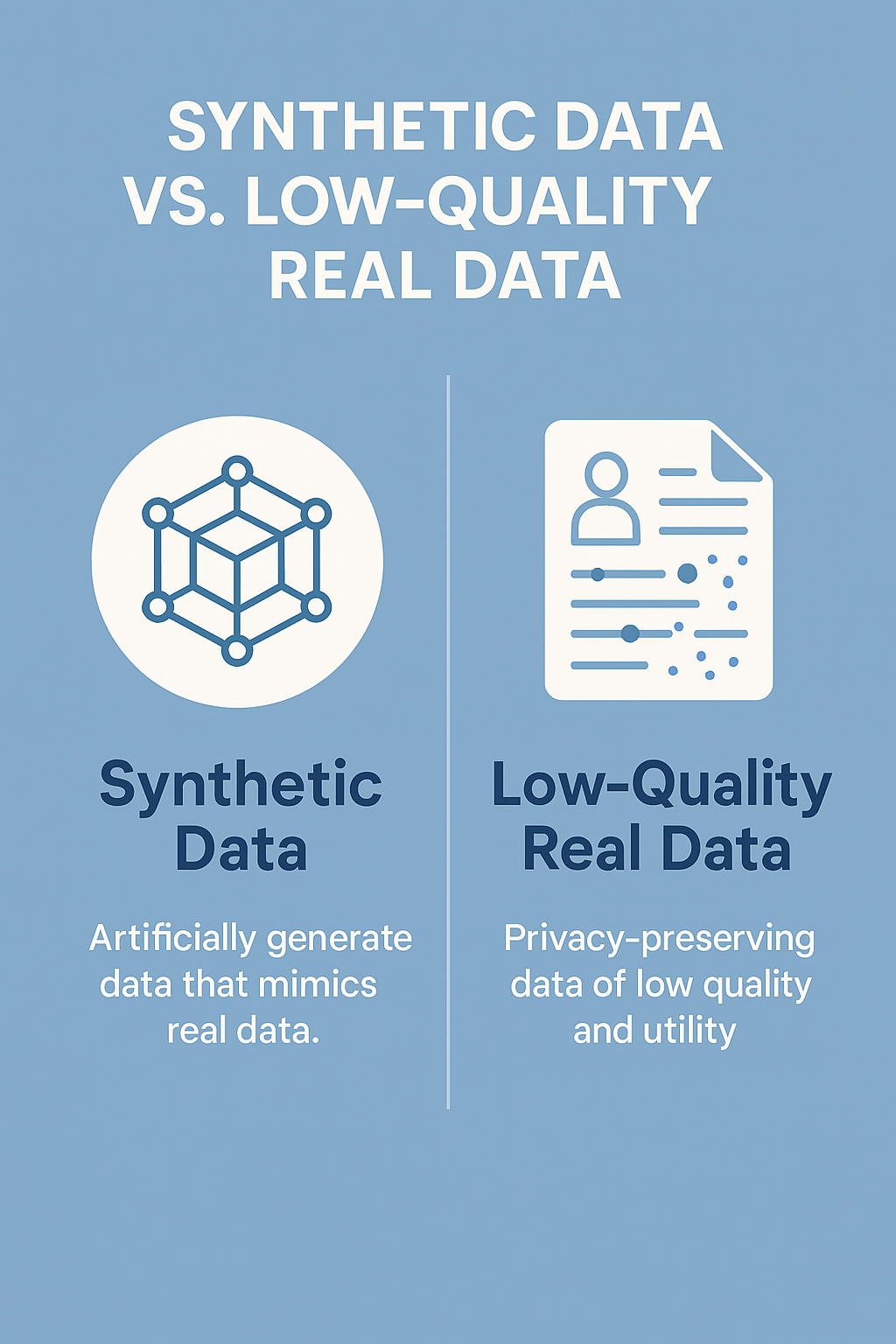
In conversations during the event, I met with some interesting folks and had long conversations about data quality. When talking about privacy-preserving data use, three terms often get conflated (at least amongst the novices): synthetic data, anonymised data, and differentially private data. While all three aim to reduce privacy risks, they differ fundamentally in construction, guarantees, and ideal use-cases.
Anonymised data is real data with direct identifiers removed or masked. Its weakness is structural: if the underlying patterns of the real dataset remain embedded, attackers can often re-identify individuals through linkage attacks or inference techniques. A growing body of research shows that even datasets without names or addresses can be deanonymised when combined with auxiliary information, because the data points are still tied to real individuals.
Differential privacy, by contrast, injects calibrated noise into queries or datasets so that the presence or absence of any individual does not materially change analytical outputs. This provides a mathematically provable privacy guarantee. But the trade-off is accuracy: heavy noise addition can distort minority-class patterns or small-sample statistical relationships.
Synthetic data takes a different route altogether. Instead of modifying real data, it generates completely artificial records that mimic the statistical properties of the source dataset. No row corresponds to any real person. This disconnection from real individuals eliminates a large class of re-identification risks and makes the data highly shareable. It does, however, require careful quality evaluation—poorly generated synthetic data can hallucinate unrealistic correlations or miss critical rare events.
Why Firms Use Synthetic Data
Firms increasingly rely on synthetic datasets for scenarios where real-world data is sensitive, incomplete, biased, or simply unavailable. Typical use-cases include:
- Product development and testing: Fintech and healthtech companies often need realistic datasets to test algorithms safely without exposing personal information.
- Machine learning model training: Synthetic data helps overcome class imbalance, enrich training sets, or simulate rare but important events (e.g., fraud patterns).
- Data sharing across organisational boundaries: Cross-functional teams, vendors, or academic collaborators can work with synthetic datasets without entering into heavy data-processing agreements.
- Accelerating regulatory compliance: In sectors such as banking, telecom, and healthcare, where privacy regulations are tight, synthetic datasets reduce bottlenecks in experimentation, sandboxing, and model audits.
From a governance standpoint, synthetic data often plays a complementary role: firms still use real data for production-grade analytics but use synthetic data for exploration, prototyping, and secure experimentation.
Alignment with the Indian DPDP Act and Rules
The Digital Personal Data Protection (DPDP) Act, 2023 emphasises lawful processing, purpose limitation, data minimisation, and protection of personal data. Importantly:
- The Act’s obligations apply only to digital personal data of identifiable individuals.
- High-quality synthetic data, by definition, contains no personal data, and therefore does not fall within the compliance net.
This creates a strategic opportunity for firms: synthetic datasets allow innovation outside the regulatory burden while maintaining alignment with the Act’s intent: protecting individuals’ data rights. Many enterprises are beginning to use synthetic data as a “privacy-by-design accelerator,” reducing the operational costs of compliance while enabling safe analytics.
Synthetic Data and Artificial Pearls: A Useful Analogy
The distinction between synthetic and real data is similar to the comparison between artificial pearls and natural pearls. Natural pearls, harvested from oceans, are biologically authentic but scarce, costly, and highly variable in quality. Artificial pearls, especially high-grade cultured pearls, are manufactured with precise control over structure, size, lustre, and durability.
In many cases, artificial pearls are actually superior to natural ones:
- They have more consistent structure.
- They are available in specific sizes and configurations designers need.
- Their strength and finish can be engineered for durability.
- They reduce dependence on environmentally intensive harvesting.
Synthetic data plays a similar role. Just as the best artificial pearls capture and improve upon the aesthetics of natural pearls without relying on oysters, synthetic datasets capture the statistical essence of real data while offering higher usability, lower risk, and greater design freedom.
In contexts where quality matters more than provenance, such as stress-testing jewellery designs or building machine learning models, the engineered version can outperform the natural one.
Cheers.
(C) 2026. R Srinivasan.
 Platforms, Protocols, DPI, DPG and more…